
The Archery GB Handicap System
The Definitive Guide to Target Archery Handicaps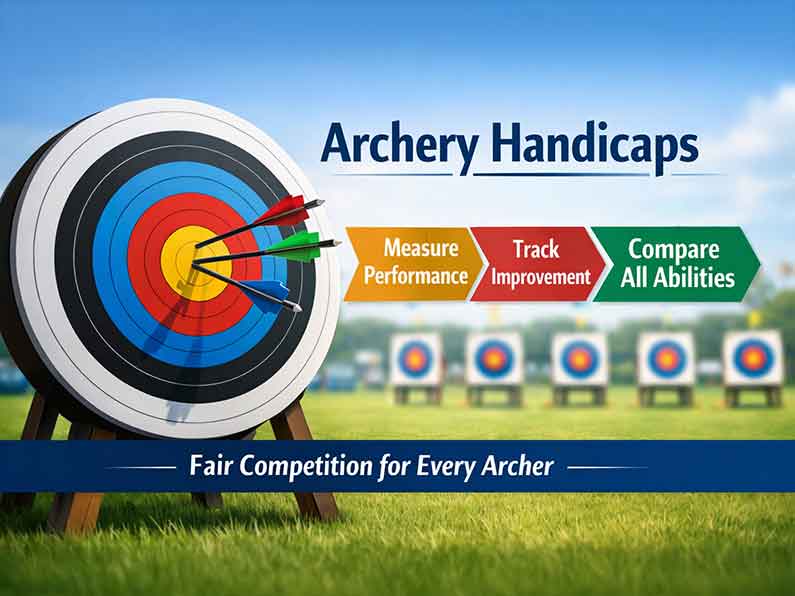
Handicaps allow fair comparison across archers of all abilities
Understanding Archery GB Handicaps
In archery, a handicap is a numerical measure of an archer’s precision and consistency. It reflects how closely an archer can group their arrows and how reliably they score across recognised rounds, rather than measuring performance on a single day. Handicaps allow scores from different rounds, distances, and formats to be compared fairly, and provide a clear way to track progress over time.
Each score an archer shoots is converted into a handicap using official Archery GB tables, and these values form the basis for both initial and in-season calculations. Only improving scores are used during a season to ensure the handicap represents the archer’s true ability, avoiding distortion from temporary dips in form or difficult conditions. At the end of each season, the best scores are averaged to establish the starting handicap for the next season.
Handicaps are independent of bowstyle, age, or gender—they measure the archer’s standard relative to the round itself. Modern tools like Golden Records apply these rules automatically, helping clubs and archers calculate, track, and use handicaps consistently and accurately.
Early History of Archery Handicaps
Handicaps originated to allow fair competition between beginners and experts, inspired by golf. Early clubs used printed tables to convert scores into handicaps, focusing on consistency and averaging multiple rounds. David Lane formalised statistical methods in the UK, creating an objective framework. While early calculations were manual, modern software automates the process while preserving the same principles.
Evolution to the Modern System
Archery GB has refined the system over time. The 2023 update extended coverage to all recognised rounds, formalised indoor and outdoor calculations, and standardised procedures for clubs. Automation ensures consistent application while still reflecting the archer’s true ability.
Why Archery Handicaps Differ from Golf
While golf and archery both use handicaps to level the playing field, the sports differ in how environmental and performance variables affect outcomes. In golf, the ball may travel hundreds of yards, but its path is relatively predictable, and factors like wind, terrain, and club choice can be compensated for. In archery, arrows travel shorter distances, yet small variations in release, bow mechanics, wind, or arrow flight have a much greater impact on where each arrow lands. Because of this sensitivity, early systems that tried to emulate golf handicaps with a single number were unreliable. Modern Archery GB tables instead focus on precision and consistency across multiple rounds, providing a fairer and more accurate measure of an archer’s ability.
The Origins and International Context of the Archery GB Handicap System
The Archery GB handicap scheme is relatively unusual internationally. World Archery, the global governing body, does not use handicaps; instead, performance is measured through ranking rounds, qualification scores, and head-to-head matchplay. Most other countries rely on classifications, league systems, or score bands rather than a formal, numeric handicap. None has adopted the Archery GB tables wholesale.
The UK system exists because of a strong club-based culture and the need for a tool that allows archers of widely varying abilities to compete fairly and track progress over time. Its development was made possible by David Lane, who applied statistical modelling of arrow groupings and scores to produce reliable tables. This approach allowed performance to be converted consistently into a handicap, accounting for variation in rounds, distances, and conditions.
Without Lane’s methodology, it is likely the UK would have followed the path of other countries, relying solely on classifications or league formats.
Today, the Archery GB handicap scheme remains a domestic tool designed to support club and national competition, monitor long-term improvement, and provide a consistent measure of performance, complementing but not replacing international ranking systems. Its combination of statistical rigour and practical application makes it distinct and effective for everyday archery in the UK.
What the Handicap System Is
A handicap is a numerical index representing an archer’s demonstrated standard of shooting.
Handicap Scale
The Archery GB handicap system uses a scale from 0 to 150, where 0 represents the highest standard of precision and 150 indicates a developing or less consistent archer. All scores and calculations for indoor and outdoor handicaps are measured on this same scale, making it easy to track progress and compare performance across rounds.
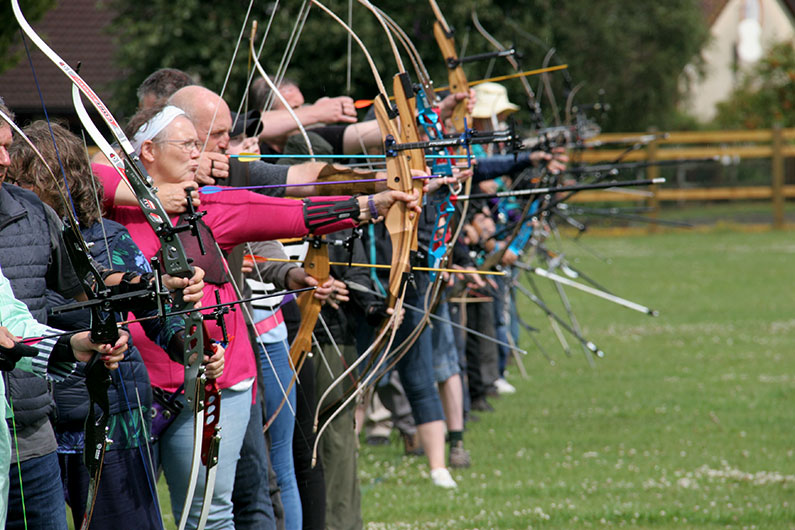
By applying the handicap, we can compare archers with different abilities, genders, and bow types, allowing all archers to compete on equal terms.
- Lower handicap numbers indicate higher performance levels
- Higher handicap numbers indicate developing or less consistent performance
Handicaps are derived from scores shot on recognised rounds and converted using official Archery GB handicap tables. They are not predictions of future scores, but reflections of what an archer has proven they can achieve.
A handicap reflects demonstrated shooting ability in recognised rounds, independent of bowstyle, age or gender.
Separate Indoor and Outdoor Handicaps
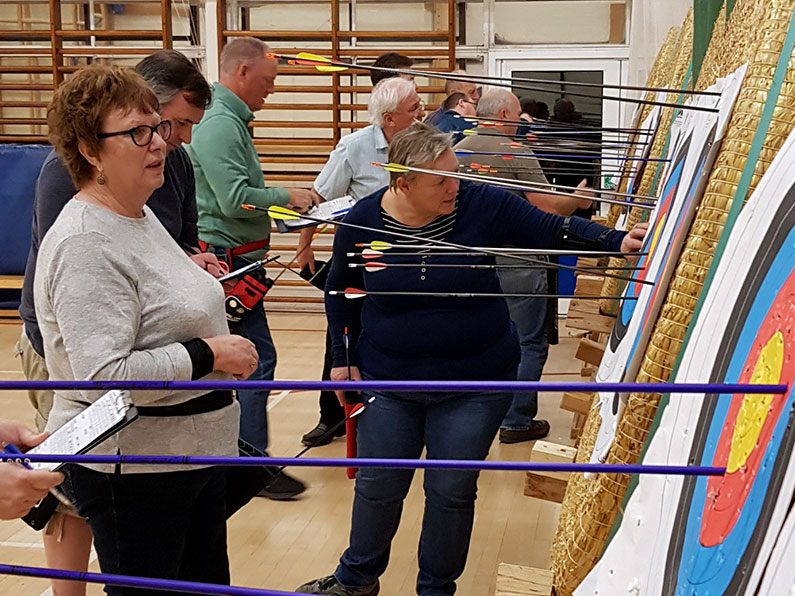
Every archer holds two completely independent handicaps:
- One outdoor handicap, based only on outdoor rounds
- One indoor handicap, based only on indoor rounds
Scores from one discipline never influence the other. Each discipline has its own season, reset date and calculation history.
Recognised Rounds and Eligibility
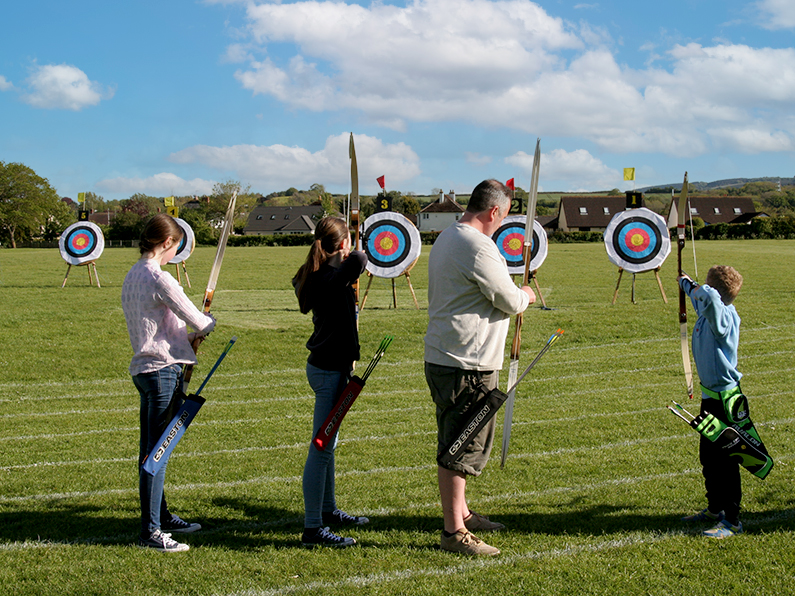
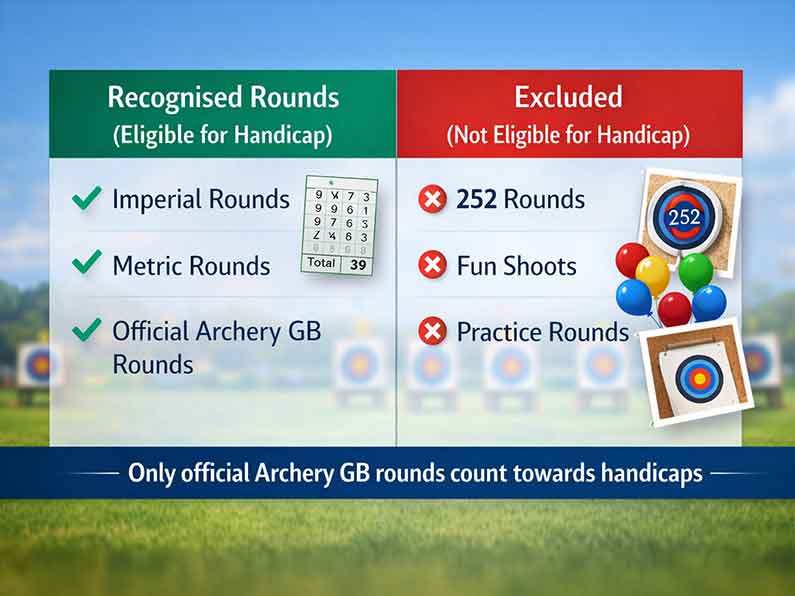
Only scores shot on Archery GB‑recognised rounds may be used for handicap purposes. These include both Imperial and Metric rounds listed in official publications.
Key principles:
- Practice ends, novelty shoots and informal formats do not count
- Scores must be shot under normal shooting conditions
- Scores may be shot at the club level or in formal competition
Important exclusion:
- 252 rounds are not included in handicap calculations. It is an outdoor round used mainly for beginners, shot at progressively longer distances (for example, 20, 30, and 40 yards). Its purpose is to help new archers develop skills and confidence at greater distances, rather than to serve as a performance benchmark for handicaps, which is why it is excluded from handicap calculations.
Handicaps and the Rules of Shooting
The Archery GB Rules of Shooting define how rounds are shot, how competitions are conducted, and which rounds are formally recognised. They do not define how handicaps are calculated. Responsibility for the handicap system sits separately within Archery GB’s Target Archery Handicap Scheme and the Shooting Administrative Procedures, supported by published handicap tables. This separation is deliberate: the Rules of Shooting ensure safety, fairness, and consistency in how archery is practised, while the handicap scheme provides a statistical framework for measuring performance across recognised rounds. Only scores shot in accordance with the Rules of Shooting and on recognised rounds are eligible for handicap purposes, ensuring the system remains consistent, transparent, and nationally standardised.
Establishing an Initial Handicap
An archer does not have a handicap until one has been formally established.
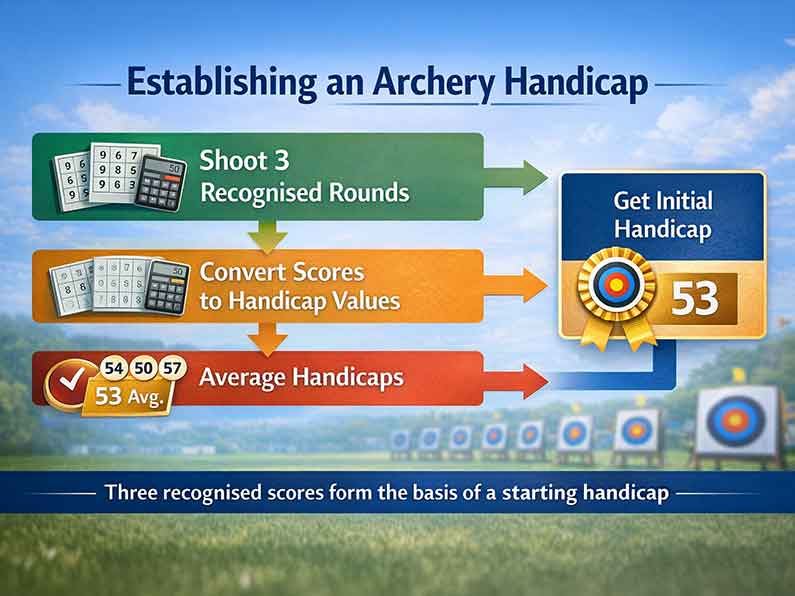
To obtain an initial handicap:
- Shoot three recognised rounds in the same discipline
- All indoor or all outdoor
- Each score is converted to a handicap value using the official tables
- The three handicap values are averaged
- The result is rounded down to the nearest whole number
That number becomes the archer’s starting handicap for the season.
Example:
- Handicap from score 1: 54
- Handicap from score 2: 51
- Handicap from score 3: 53
Average: (54 + 51 + 53) ÷ 3 = 52.66
Starting handicap: 52
Handicap Tables
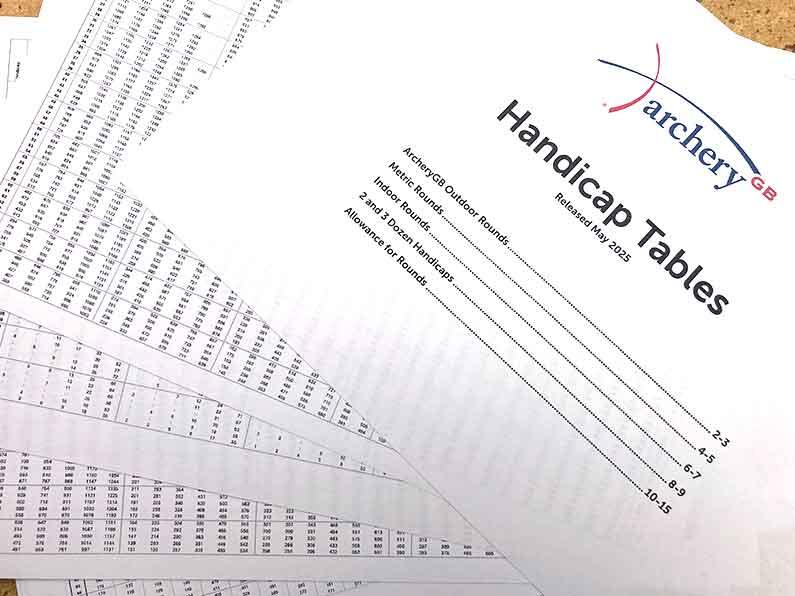
Handicap tables are the foundation of the Archery GB handicap system. They define the mathematical relationship between a score achieved on a recognised round and the handicap value that represents that performance.
The tables account for:
-
The round format and scoring system
-
The number of arrows shot
-
The distances involved
-
Whether the round is shot indoors or outdoors
Each recognised round has its own defined score-to-handicap mapping. This allows performances from different rounds, distances and formats to be compared on a single, consistent scale.
Origin and Governance
The statistical methodology underpinning the handicap tables was originally developed by David Lane. His work established a robust and repeatable approach to modelling expected scores and translating them into handicap values.
Archery GB now maintains, publishes and governs the official handicap tables. This ensures that the system remains consistent, transparent and applied uniformly across all clubs, competitions and record-keeping systems.
Use in Practice
In day-to-day use, most archers never interact with the handicap tables directly. Scoring software such as Golden Records applies the tables automatically when scores are entered, converting each recognised round score into a handicap value in accordance with Archery GB rules.
This separation between published methodology and automated application is what allows the handicap system to be both technically rigorous and simple to use in practice.
Handicap Examples
Example 1: Establishing an Initial Handicap
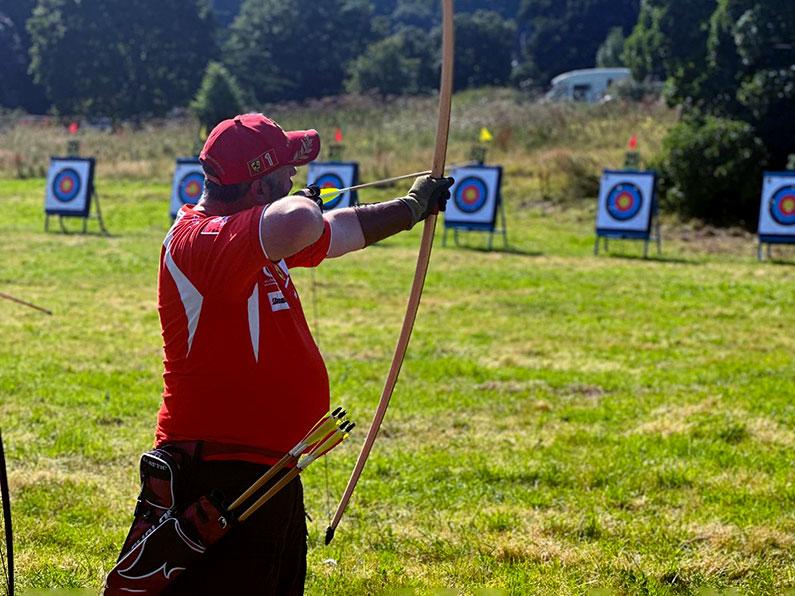
John is an adult longbow archer shooting outdoors. He has not previously held an outdoor handicap and needs to establish one.
Over the course of several weeks, John shoots three recognised outdoor rounds:
- York round, which converts to a handicap of 57
- Hereford round, which converts to a handicap of 55
- Bristol I round, which converts to a handicap of 56
The three handicap values are averaged:
(57 + 55 + 56) ÷ 3 = 56
Rounded down to the nearest whole number, John’s initial outdoor handicap is
Handocap = 56
John now holds an official outdoor handicap, and subsequent recognised scores can be used to improve it.

Example 2: Improving a Handicap During the Season
Jenny is an adult recurve archer who already holds an outdoor handicap of 50, at the start of the season.
Later in the season, Jenny shoots a recognised outdoor round. When the score is entered, it converts to a handicap value of
46.
Because this value is lower than her current handicap, it represents an improvement. The new handicap is calculated by averaging the two values:
(50 + 46) ÷ 2 = 48
Rounded down to the nearest whole number, Jenny’s new outdoor handicap becomes
Handocap = 48
This updated handicap now applies for the remainder of the outdoor season.
Example 3: A Worse Score During the Season
Alex is a junior compound archer with a current indoor handicap of
22.
At a later shoot, Alex records another recognised indoor score. When entered, this score converts to a handicap value of
26.
Because this value is higher than Alex’s current handicap, it does not represent an improvement. As a result:
- The score is recorded for results and personal records
- It is ignored for handicap progression
- Alex’s indoor handicap remains unchanged at
Handocap = 22
This ensures that occasional poor performances, difficult shooting conditions, or temporary dips in form do not worsen an archer’s handicap during the season.
Consistency and Best Scores
The system favours consistency.
A single exceptional score will not radically alter a handicap unless similar performances follow.
This protects the integrity of handicap competitions and ensures the number reflects sustained ability.
In‑Season Handicap Updates
Once established, a handicap may only improve during a season.
Process:
- A recognised round is shot
- The score converts to a handicap value
- That value is compared to the current handicap
If the new value is lower, the two are averaged and rounded down. If it is higher, it is ignored.
This ensures gradual, realistic movement rather than sudden jumps.
End‑of‑Season Recalculation
At the end of each season, handicaps are recalculated.
For each discipline:
- Identify the best three handicap values achieved during the season
- Average those three values
- Round down to the nearest whole number
This becomes the starting handicap for the new season.
If fewer than three improvements were recorded, the available values are used in line with Archery GB guidance.

Season Dates
Outdoor season reset: 1 January
Indoor season reset: 1 July

Mathematics Behind the Tables
The handicap tables are based on statistical modelling of arrow group sizes and scoring probability.
At a simplified level:
- Tighter groups produce higher average scores
- As distance increases, group spread increases
- Different bowstyles exhibit different scoring distributions
The tables convert these probabilities into expected scores for each handicap value. While the actual mathematics is complex, the outcome is practical: equivalent standards produce equivalent handicaps across different rounds and bowstyles.
Use of Handicaps in Practice
Handicaps are commonly used for:
- Club handicap competitions
- Fair comparison across mixed‑ability shoots
- Tracking long‑term progress
- Supporting results administration
They are a tool for fairness and understanding, not a judgment of worth.
Golden Records and Automation
The bowmen of Danesfield use Golden Records software to manage scoring, handicaps, and records, and it applies the Archery GB handicap system exactly as defined in the Shooting Administrative Procedures.
When a recognised score is entered by an archer:
- The raw score is automatically converted into a handicap value using the official Archery GB handicap tables
- If the score represents an improvement, the system averages the new value with the archer’s current handicap and rounds the result down to the nearest whole number
- If the score is worse than the current handicap, it is retained for results and personal records but ignored for handicap progression
For archers establishing a handicap, Golden Records waits until three recognised scores exist in the same discipline and then calculates the initial handicap automatically. At the end of each season, it identifies the best handicap values achieved and recalculates the starting handicap for the new season in line with Archery GB rules.
The benefit of this automation is twofold. For clubs and records officers, it removes subjective judgment, manual calculation and the risk of inconsistency. For archers, it provides confidence that handicaps are applied fairly, transparently and identically for everyone, regardless of when or where scores are submitted.
In practice, this means the handicap system works quietly in the background, allowing archers to focus on shooting whilst maintaining accurate, rule-compliant records.

Members and Golden Records
Members of the Bowmen of Danesfield have access to their own personal space on Golden Records, where they can view their handicaps and much more.
Contact records@bowmenofdanesfield.co.uk
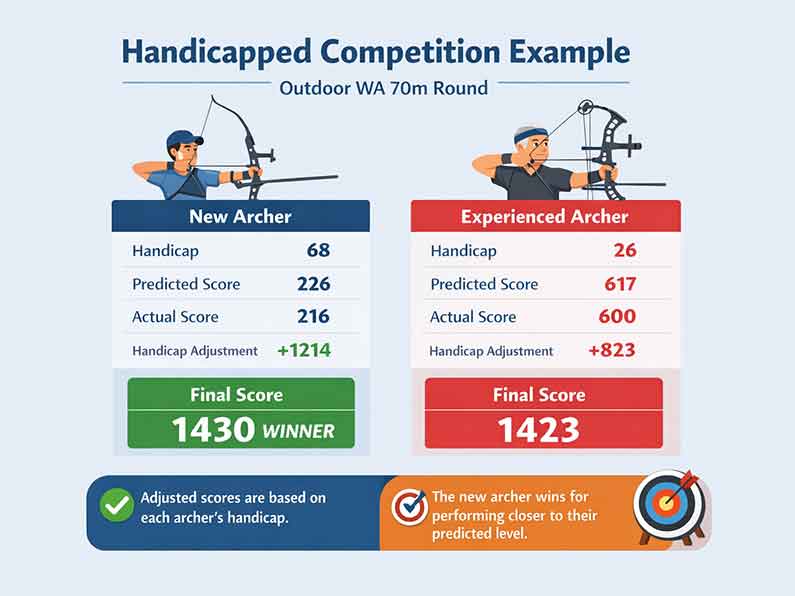
Predicted scores come from an archer’s
handicap. The difference between
actual and
predicted scores sets the
handicap adjustment, letting archers of all abilities compete fairly.
Handicapped Competitions in Practice
Handicaps allow archers of different abilities to compete on equal terms. In these competitions, raw scores alone don’t indicate who performed best relative to skill level; a system is needed to adjust scores so performance is measured against ability rather than absolute points.
How Predicted Scores Work
A predicted score is the score an archer is expected to achieve on a specific round if they shoot exactly to their handicap. It is determined from the official Archery GB handicap tables, which take into account the round format, distance, and number of arrows.
- The handicap is the input, representing the archer’s current standard.
- The tables use that handicap to calculate the predicted score for that round.
- This predicted score provides a baseline for comparison.
Handicap Adjustments in Competition
The difference between an archer’s actual score and their predicted score is used to calculate a handicap adjustment. This ensures that archers are rewarded for performing above their level and that beginners can compete fairly against experienced archers.
Example – Outdoor WA 70m Round:
| Archer | Handicap | Predicted Score | Actual Score | Handicap Adjustment | Final Score |
|---|---|---|---|---|---|
| New Archer | 68 | 226 | 216 | +1214 | 1430 |
| Experienced Archer | 26 | 617 | 600 | +823 | 1423 |
- The predicted score comes directly from the Archery GB tables.
- Even though the new archer scored fewer raw points, after the handicap adjustment, they win because they performed closer to their predicted score.
This system demonstrates how handicaps measure performance relative to ability, making competitions fair and meaningful for archers of all standards.
Common Misunderstandings
Handicaps are not classifications
Although often mentioned together, handicaps and classifications serve different purposes. Classifications are discrete achievement levels earned by shooting specific qualifying scores. Handicaps, by contrast, are a continuous numerical measure of performance that changes gradually as an archer demonstrates improvement.
A single score does not define a handicap
The handicap system is designed to reward consistency rather than isolated performances. One exceptional score will not cause a sudden drop in handicap, and one poor score will not cause it to rise. Improvement must be demonstrated through repeatable results over time.
Indoor and outdoor handicaps are completely separate
Indoor and outdoor shooting involve different distances, conditions and demands. For this reason, scores shot indoors do not affect outdoor handicaps, and vice versa. Each discipline has its own scores, calculations and seasonal cycle.
Handicaps are not adjusted for age, gender or bowstyle
Handicap numbers are not modified to account for age, gender or equipment. Instead, the system measures performance relative to the round being shot. This ensures that shooting under equivalent standards produces equivalent handicaps, regardless of who the archer is or what they shoot.
Handicaps measure demonstrated performance, not potential
A handicap reflects what an archer has achieved under recognised conditions, not what they might achieve on a particularly good day. This is why handicaps change steadily rather than dramatically.
Links to more information
Archery Geekery – Handicap Calculator
Archery Geekery – The maths behind the tables
Archery Calculator – Handicap Calculator
Pros
- Tracks Improvement Over Time: Measures consistency so archers can see real progress, not just one-off performances.
- Supports Fair Competition: Allows scores from different rounds, distances, and conditions to be compared meaningfully.
- Separates Indoor and Outdoor Performance: Ensures each discipline is assessed fairly.
- Automated Calculation Reduces Errors: Software like Golden Records applies the rules precisely.
- Encourages Consistency and Training Focus: Repeatable performance motivates improvement and highlights areas to train.
- Simple to Understand Once Explained: The logic of score → handicap → improvement is easy for all levels.
Cons
- Slower Reflection of Exceptional Performances: One outstanding score does not immediately improve a handicap.
- Dependent on Recognised Rounds: Casual practice or fun shoots do not influence handicaps.
- Indoor/Outdoor Separation May Confuse Beginners: Indoor and outdoor handicaps are entirely separate.
- Handicap Tables Can Seem Abstract: Statistical modelling may feel opaque, though software automates it.
- No Adjustment for Age, Gender, or Bowstyle: Ensures fairness, but some archers may expect adjustments.
From Handicaps to Classifications
The handicap system provides a powerful way to measure consistency, compare performances across rounds, and enable fair competition between archers of different abilities. It answers the question: how consistently am I shooting, relative to recognised standards?
What handicaps do not do is formally recognise achievement. They change gradually, track performance over time, and are designed to smooth out short-term variation rather than mark milestones.
That role is fulfilled by the Archery GB classification system. Classifications award defined achievement levels based on specific scores shot under recognised conditions, providing visible benchmarks of progress and formal recognition of an archer’s standard.
Together, handicaps and classifications form a complementary pair: handicaps track performance and consistency, while classifications recognise attainment. To understand how achievement is recognised and how archers progress through nationally defined standards, the next guide explores the Archery GB Classification System in detail.